
Life is full of good surprises, no doubt about it.
The early days
Back in 1988–1992, I wrote a few chiptunes for the STf, directly in assembly. That was a VERY long process! At first I used a sort of tracker made by Ziggy Stardust, and later the one Ben wrote for Jess, which mimicked tracker logic with channels simply separated by commas!! That period gave birth to the Plasma Screen muzak (by DIM/OVR), plus a few others that were never used (Frenetic and Zoomer Preview).
Decades went by. I discovered maxYMiser, a fantastic tracker, but far too complicated for me after so many years of working with DAWs. So I gave up (laziness has always been one of my talents!) and was happy just listening to the music in new demos. I had found my way back into this fantastic world when the First Love demo came out.
Nothing much happened for a few years… until 2025, when I discovered Arkos Tracker 3 (AT3). It was appealing enough for me to invest some time in it, but it still wasn’t quite enough.
Meeting Sandor
In the first half of 2026, I started talking with Sandor about zeST, the FPGA-based Atari ST clone created by Zerkman (that’s where the “ze” in zeST comes from, by the way!). We also talked about 3D-printing a case for the tiny FPGA board zeST runs on, and Sandor ended up sending me a very cool case for my own zeST. So nice!
As we chatted, Sandor also shared some of the great tunes he had made with AT3. So I wasn’t the only ST musician stuck with this tracker. Phew!
Sommarhack 2026: a mystery
Later on, I had the chance to attend Sommarhack 2026. One of the demos shown there was a lovely, very short one called “Dither Dance”, by Steen and Rapido. (I didn’t realize right away that Sandor and Steen were the same person. Rapido/Odipar, who was at Sommarhack too, told me. Lucky me!)
I really liked the music, and I immediately wondered how such a tune could sound so good. As far as I knew, Sandor/Steen mostly used AT3, which is built mainly around the Amstrad CPC’s AY/YM sound chip. This tracker has some limitations, but it can export SNDH music files for the STf, thanks to GGN. At the time, though, AT3 couldn’t do anything SID-related, and yet Sandor’s tune used timer effects. Something new was going on here, and I was puzzled!
A new tracker for the STf
So I reached out to Sandor. He told me he had started building a tracker for the STf that could play pulse-width modulation (PWM) sounds, in other words the kind of SID sounds you hear on the great C64. And it ran on macOS (perfect for me), Linux and Windows.
That got me hooked. I thought: finally, a tool actually dedicated to YM usage on STf, that will let me make music easily, without struggling the way I did with some other trackers like Furnace.
To be fair, Furnace is quite mature, especially since it can export to SNDH with timer effects, thanks to the work of Pator and SPKR (although, for some reason, the STf + timers fork isn’t very widespread). I even managed to release three chiptunes with it, but it was a real struggle. Same causes, same effects: after years of using modern DAWs (mostly Logic Pro X, a descendant of the almighty Notator!), I just find it far too complicated. Not to mention that it was also quite hard to communicate with its developers.
So I thought: why not keep working with Sandor and help move the project forward?
He gave me a pre-release of RhYMe: version 0.53, back in September 2026 (we’re at 0.9.0 beta today, see https://rhyme.st/).
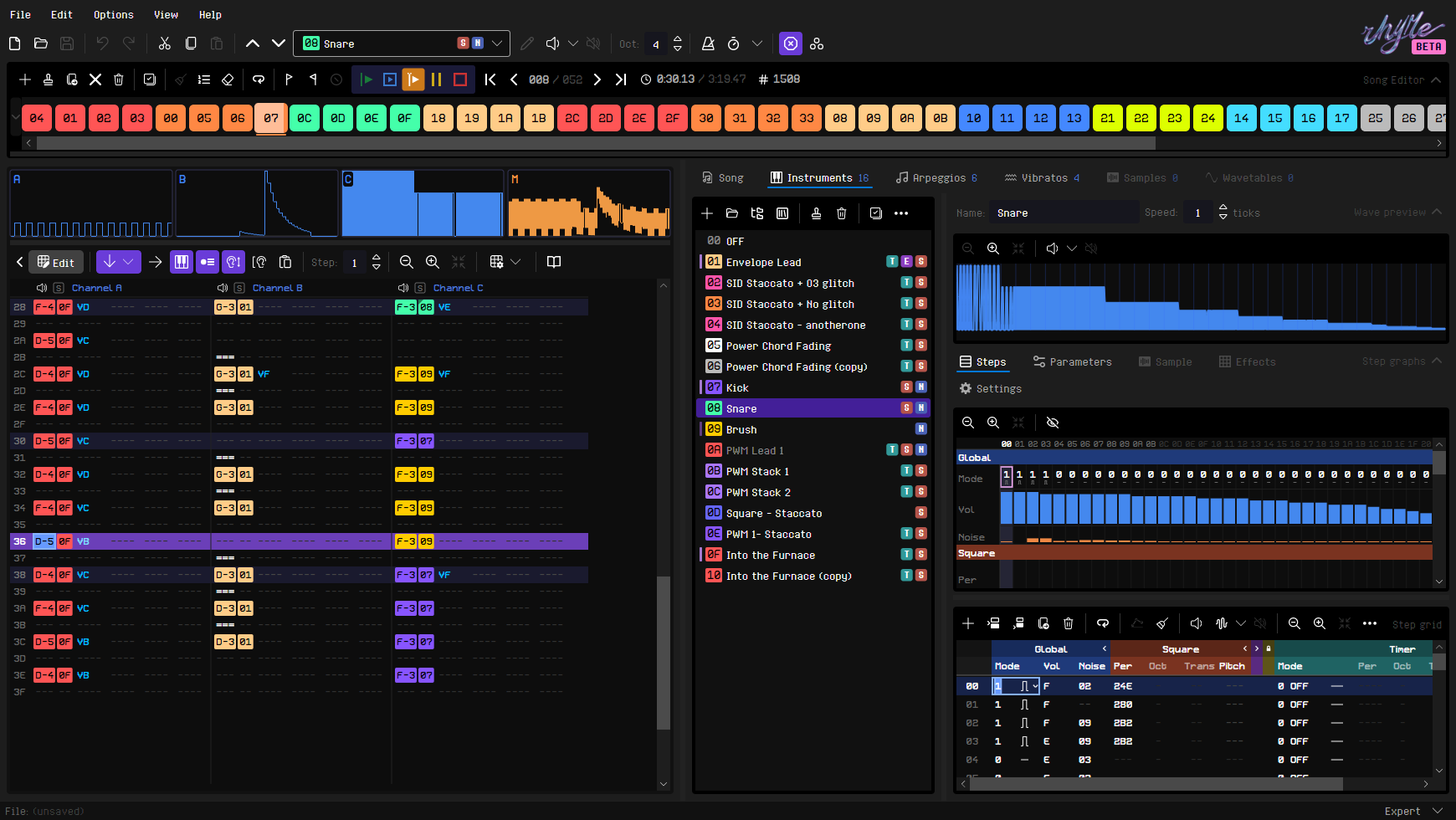
I found the interface really nice and very intuitive. It was a real relief to see that you could make YM music simply again, without having to be a huge geek about music production. Sandor took my feedback into account and improved things as we went along.
Rapido and the 99.9%
Then Rapido came into the picture (he had probably been involved all along, but I didn’t know it). He worked on making the tracker’s own audio playback on modern systems match what you hear on the Atari, whether on real hardware or in Hatari emulator. We hit a few snags, and sometimes the two didn’t quite match, but it kept improving. Today they’re, let’s say, 99.9% identical, which is excellent. It’s the only cross-platform tracker that achieves this.
For me, it was a real revolution: I was in regular contact with the developers, who could adapt the tool to my requests and expectations. A dream come true!
Tunes, features and what’s next
Of course, I wasn’t the only one: others joined in later. I was able to create a few tunes, mixing samples and PWM sounds, and some of them were used in the Erfurt Megademo (main screen and reader screen). The demo came out at the very end of October (on the 31st, I think), and it sounded really good, not to say that my tunes pleased to 505 ; I was honored!
After that, more features appeared, like wavetables and buzzer sounds with volume fade-out (which is unique). There are lots of things that make life easier too, such as automatically selecting a track’s volumes to lower or raise them, or drawing sound curves with the mouse. You can also combine different effects (PWM, buzzer, whatever you like) with timers at different stages of a sound definition, which makes it very precise and fine-grained. My sounds on the Atari STf started improving a lot, and they still surprise me compared to what I thought was possible.
Sandor has since moved on to the wavetable side, and some new tunes using it are on the way.
I think I’ve made 4 or 5 tunes with RhYMe since September, which is huge for me, because I do everything by hand, step by step. It’s a really interesting process, too: sometimes you get stuck, and sometimes you move forward and the inspiration just comes. In some cases, I start from existing pieces, and always drift so far that the result is completely different. Either way, it’s always an interesting journey. One of my latest RhYMe tunes, “En route vers 1992”, was released at Silly Venture WE 2026. It uses many timer effects at the same time, plus 16 kHz samples at 4 bits resolution - the samples replay sound surprisingly good, to the point that some people thought it was an STe tune!! Hopefully, some other RhYMe users also released tunes at the party: Sandor and Minestrone also entered the competition (see the Atari ST/STE YM2149 Music results).
So thank you, Sandor and Rapido, for your work.
I really believe it will help musicians who aren’t very experienced with trackers get started and create unique sounds, typical of the old Atari STf we love so much.
Thanks for reading all the way to the end!


Add comment