
With the imminent release of the Atari Falcon 030, Reservoir Gods have updated their development tooling to support the exciting new DSP 56001 chip in these computers. We can't wait to get our hands on one of these bad boys!
Well, we may be 33 years late to the party - but better late than never! The rg cross-development tools now fully support the Motorola DSP56001.
rg-asm
rg-asm now features comprehensive support for the Falcon DSP: the complete DSP56001 instruction set, dual parallel moves, DO loops, all memory spaces. It can emit in many formats, including standard .LOD, .P56, .OUT, .CLD/.CLN, as well as raw binary.
One of really nice new features is support for mixed mode assembly. You can now write your 68030 code and DSP code in a single file, and seamlessly switch between both.
- Equates & constants: 68k constants are automatically inherited in DSP blocks
- Symbol export: DSP routines and labels export back to the host 68k code as equates
- Macros & structs: Share macros and structs between your DSP and 68k code
- Flexible layout: You can embed DSP code as either 3-byte per word packed or 4-byte per word unpacked
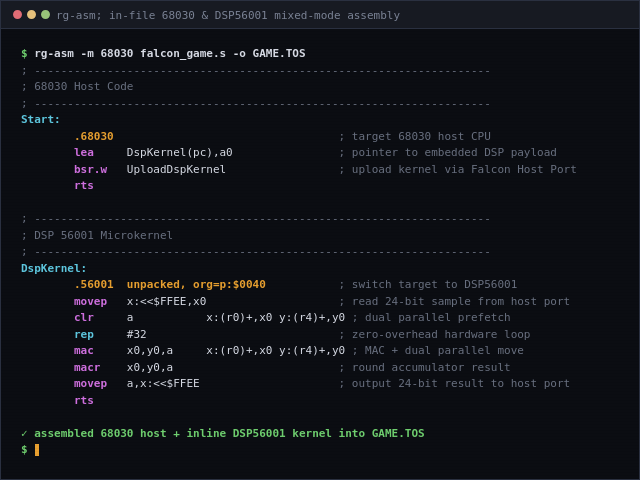
rg-asm runs as a single executable with no dependencies, simply download and run:
rd-dis
rg-dis can now dissassemble DSP binaries!
It has full support for the Atari Falcon030's DSP 56001 chip. It works on standalone binaries (.LOD, .P56, .COFF, .OUT object binaries) - but it can also disassemble DSP code that is embedded directly inside 680x0 executables.
To make reverse engineering as readable as possible, rg-dis marks the boundaries of DO loops, annotates per instruction cycle cost and detects embedded ASCII strings.
With its full understanding of the DSP56001 memory map, it annotates on chip peripheral and control register access - including the host interface, SSI, SCI and interrupt vectors, explaining what each hardware access is doing.
It also automatically detects jump tables in your DSP code, defining them with symbolic labels rather than raw absolute values so your dissassembled code remains relocatable and editable.
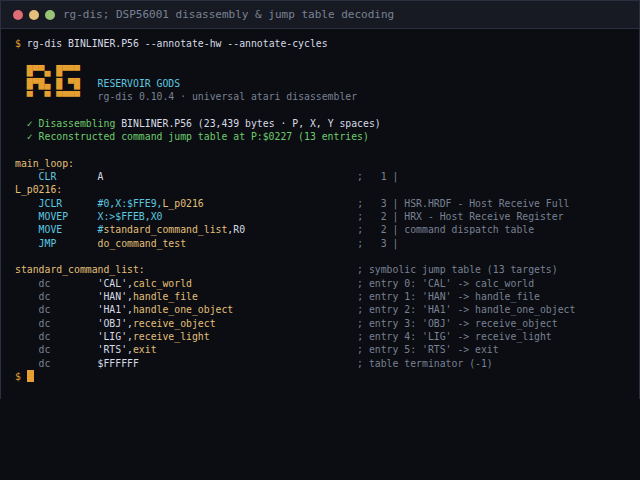
g-dis is a single binary with no dependencies. Just download and run:
We'll end here with some wise words from a famous scener that rg-dis extracted from his DSP replay routine:
dc $624954,$6D4153,$544552,$202020 ; "bITmASTER "dc $6E6F20,$445350,$202D20,$6E6F20 ; "no DSP - no "dc $66756E,$202121 ; "fun !!"

Comments